


Learn about bow legs, knock knees and hyperextended knees in children.

Leg deformities refer to genu varum (knees curved outward, or bow legs) and genu valgum (knees curved inward, or knock knees), in which the knee joint angle falls outside the normal range. There are many causes, but most are acquired, and leg deformities often develop from poor posture and everyday habits.
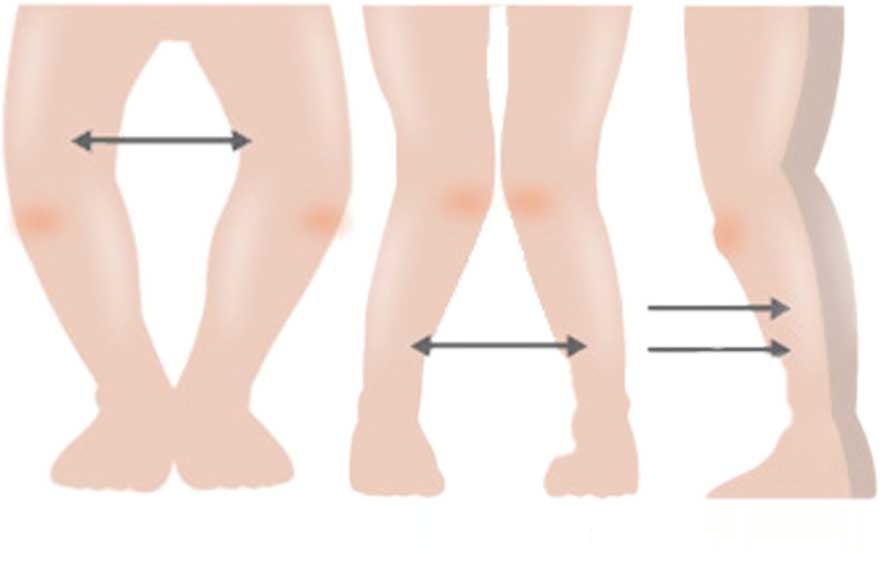
Genu varum, also called bow legs or O-shaped legs, is when the knees do not touch when standing with the feet together, and the legs curve outward in an "O" shape. In children up to about age 2–3, the legs may be or appear bowed. However, if the bow legs continue after age 3, it is a good idea to have an examination. If not treated and corrected early, it can lead to knee pain and degenerative arthritis.
Genu valgum, also called knock knees or X-shaped legs, is when the knees touch but the inner ankles stay apart when standing with the legs together, so the legs curve inward in an "X" shape. Children up to about age 4–5 may have mild knock knees or bow legs. However, if knock knees continue after age 7, the legs may stay X-shaped into adulthood. It is caused by habits such as walking incorrectly, poor sitting posture and standing with the toes pointing inward.
Genu recurvatum occurs when the ligaments of the knee joint become loose and the joint bends back too far. It is most often seen in children and women. As the knee bends backward, muscle tone also weakens and a gap opens between the knees, causing the legs to curve. Because the body's center of gravity also shifts forward, there is a very high risk of secondary problems in addition to the knee joint problem.