



This surgery preserves as much of your own shoulder joint as possible.




Arthroscopic rotator cuff repair treats torn shoulder tendons through small incisions.

1 hour

2cm

General

Minimal

After 1 week

After stitch removal

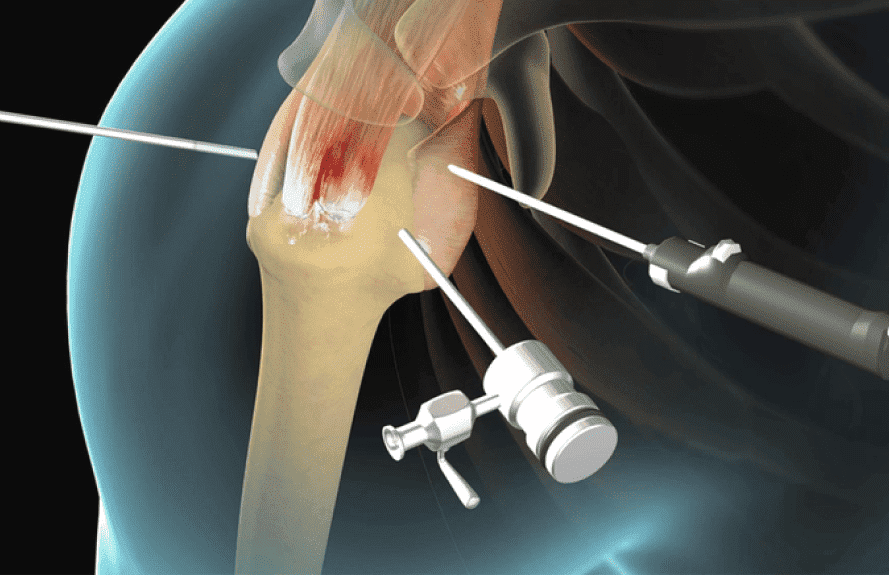
Through a minimal incision of less than 1 cm in the shoulder, an arthroscopic camera and surgical instruments are inserted into the joint to diagnose and treat the problem. Because the damaged area can be seen directly on the screen, torn tendons can be repaired or inflammation removed depending on the extent of the damage.
The arthroscope can reach areas that are hard to see on CT or MRI, making it effective for chronic pain of unknown cause and shoulder conditions that have not improved with conservative treatment.

Rotator cuff damage and impingement → Rotator cuff repair
Shoulder impingement syndrome → Acromioplasty
Frozen shoulder → Arthroscopic capsular release
Calcific tendinitis → Calcium deposit removal
A small opening of less than 1 cm is made in the shoulder joint, and an arthroscope 2–5 mm in diameter is inserted into the joint.
Through the arthroscope, the sources of pain inside the joint (cartilage, synovium, joint capsule, etc.) can easily be seen on the monitor.
The medical team makes a diagnosis while viewing the clearly visible lesion and proceeds with surgery right away.
Before Surgery (X-ray)
After Surgery (X-ray)
This surgery preserves as much of your own shoulder joint as possible.
A brace is worn for about 4–6 weeks after surgery.
For 6 weeks starting right after surgery, step-by-step exercises are done to relieve pain and prevent adhesions at the surgical site.
Exercise that uses the whole body is possible from 3–4 months.
Exercise that uses the shoulder is possible after 5–6 months.


