




Relieves chronic knee pain.



Total knee replacement restores a severely damaged knee with an artificial joint.

About 1 hour

About 10 cm

Spinalor General

Day after surgery

After 1 week

After stitch removal

This surgery replaces a knee joint severely damaged by injury or disease with an artificial joint made of metal and special plastic. When only part of the joint is damaged, the healthy part is preserved as much as possible and only the damaged part is replaced (partial knee replacement).
However, when cartilage damage is so severe that bone rubs on bone, total knee replacement is performed, replacing the whole joint to restore function.
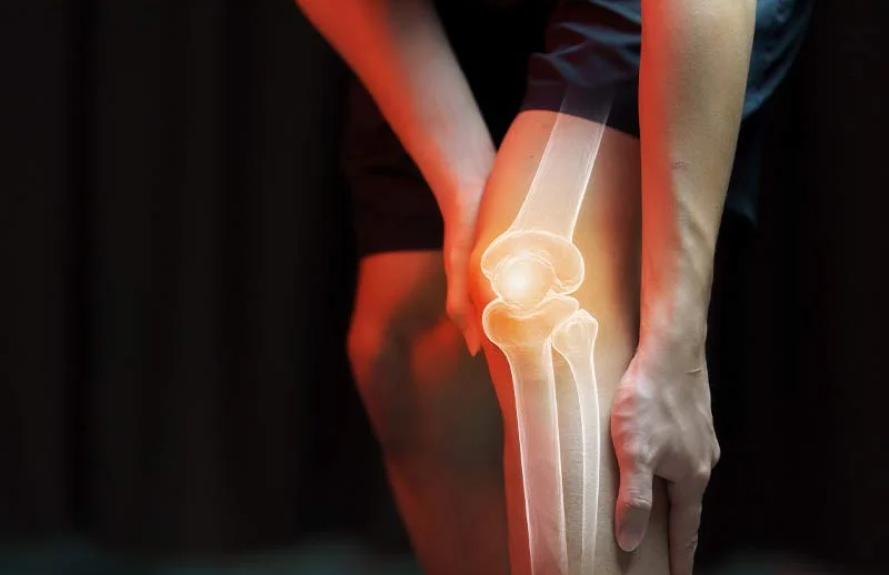

Severe cartilage damage from degenerative arthritis with progressing knee deformity
Pain or stiffness severe enough to make daily life difficult
Pain that persists even at rest
Severe pain when going up or down stairs
Pain that keeps you awake at night
Severe bow-leg (O-shaped) deformity of the knee
The knee is stiff and hard to bend or straighten
No improvement with conservative treatment (medication, physical therapy or injections)
Surgery is performed under spinal anesthesia.
The knee is opened and the damaged joint surfaces are removed.
An artificial joint made of special materials is inserted.
The implant, made of cobalt-chrome and titanium alloys that cause few rejection reactions and take over the function of the joint surface, is further secured to the bone with bone cement.
The surgery takes about 1 to 1.5 hours (per knee).
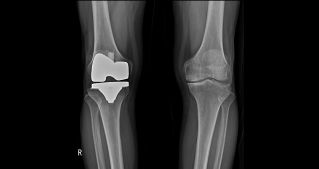
Before Surgery (X-ray)
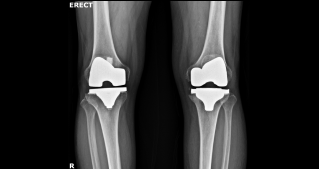
After Surgery (X-ray)
Relieves chronic knee pain.
The knee's range of motion improves, so it can bend more than 120 degrees from full extension.
Bow legs caused by worn cartilage are corrected.
On day 1, keep the leg raised above heart level while lying down (leg elevation) and begin walking with a walking aid.
On day 2, repeatedly tighten the knee, lift the straightened leg, hold for 5 seconds and lower it (quadriceps strengthening). The first wound dressing is done, and knee-bending practice and CPM (continuous passive motion) rehabilitation begin.
On days 3–4, CPM and quadriceps strengthening continue, and you practice walking on your own with a walking aid.
On days 5–6, you practice fully independent walking, including climbing low and then higher stairs and stepping over obstacles.
On days 7–14, exercise therapy continues: knee-bending exercises, CPM up to 130 degrees, ankle exercises, straight-leg raises and walking without a walking aid.
From 2 weeks to 6 months after discharge, you receive outpatient treatment and follow-up tests (inflammation tests, X-rays, etc.).
From 6 months to 1 year after discharge, continue regular rehabilitation exercise (swimming, walking, etc.) and weight-bearing walking.
After 1 year, a check-up is done to examine the surgical site for inflammation and to check the artificial joint for any problems.


