




Spinal stability is restored after the procedure.




Vertebroplasty reinforces a fractured vertebra with bone cement, without an incision.

About 1 hour

2cm

Local anesthesia

Early walking

Discharge after 1–2 days

After stitch removal

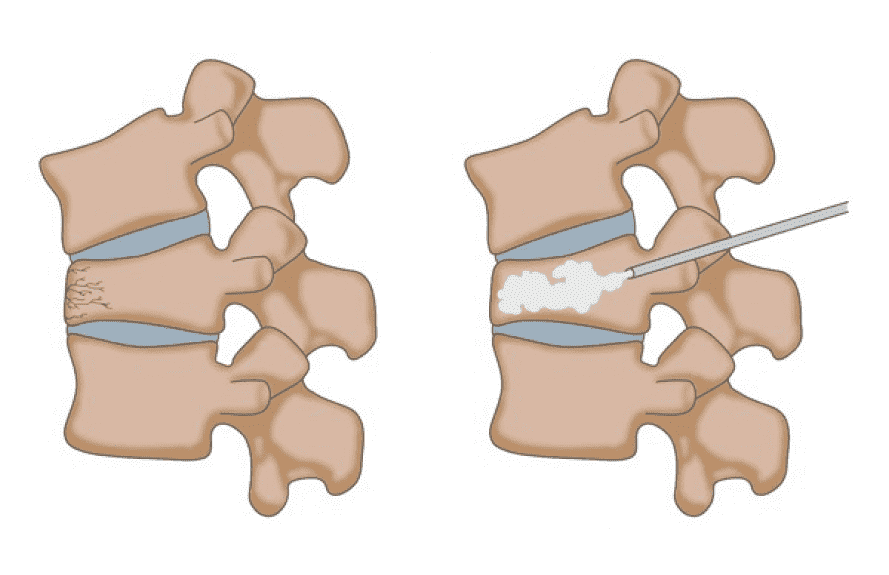
For a spinal fracture, a needle is inserted into the fracture under local anesthesia and bone cement is injected. It is a minimally invasive procedure that reinforces the broken bone and relieves pain without an incision.Spinal fractures mainly occur in two situations.
In older patients whose bones are weakened by osteoporosis, a relatively minor injury can cause a compression fracture; in younger people, falls or car accidents can cause fractures from severe trauma.

Osteoporosis patients with little pain relief after 2–4 weeks of conservative treatment
Patients with a spinal compression fracture caused by a malignant tumor
Patients with a spinal fracture after trauma
Patients with a painful vertebral hemangioma
Patients with multiple myeloma
X-ray, CT, MRI and blood tests are used to check for tumors or inflammation and to determine accurately whether there is a fracture and how severe it is.
Local anesthesia is given at the fractured vertebra.
While the position is monitored with a C-arm (image intensifier), a tube is inserted into the damaged vertebra.
Through the tube, a drill is used to make space for the bone cement.
Bone cement that is safe for the body is injected safely at low pressure to fill the space narrowed by the fracture.
The cement hardens inside the vertebra within minutes and stabilizes the spine. Depending on the patient's condition, several vertebrae can be treated at once.

Before Surgery
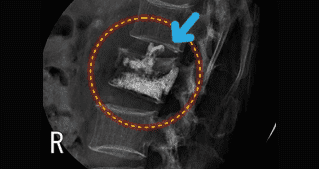
After Surgery
Spinal stability is restored after the procedure.
It relieves pain effectively and is minimally invasive, with no skin incision.
Early walking and discharge are possible on the day of the procedure, and there is no age limit.
For patients with a suspected spinal tumor, diagnosis and treatment can be done together.
After the procedure, you rest for a while before you start walking.
You can shower after the stitches are removed.
For a while, avoid lifting heavy objects or bending your back excessively.
If you have osteoporosis, continuing osteoporosis treatment helps prevent new fractures.
Right after surgery you can walk to the bathroom, and you are usually discharged after about 5 days. The wound needs care after surgery, and you may feel some stiffness from the implant.
Limit movement as much as possible and wear a brace when you move.
Leg raises lying down, stretching and short exercise sessions are possible, and light walking or office work is fine.
Start spinal
stabilization exercises.
Start spinal strengthening and flexibility exercises; light work is possible.


