




Learn about balloon neuroplasty and percutaneous epidural neuroplasty, how they are performed and their advantages.

About 30 min

Under 1 cm

Sedation

Same day

Discharge after 2 days

After stitch removal

A catheter is placed in the narrowed spinal canal, a balloon is inflated to widen it, and medication is injected around the nerve branches. With a short procedure time of about 20 minutes, it can be performed safely even in older patients, and it can be applied to a variety of spinal conditions such as spinal stenosis, lumbar disc herniation and lower-limb paralysis.
After local anesthesia at the tailbone, a thin tube (catheter) about 2 mm wide is inserted to inject medication directly into the inflamed or adhered nerve area that causes pain. During the procedure, the approach of the catheter, the injection of medication and the separation of tissue are checked directly on a fluoroscopic image intensifier, allowing precise treatment.
Because neuroplasty injects medication directly into the problem area and blocks inflammatory substances, it is highly effective in relieving pain and reducing inflammation and swelling. It also suppresses nerve swelling and inflammation in patients whose spinal condition is advanced enough to require surgery, which can help delay the timing of surgery.
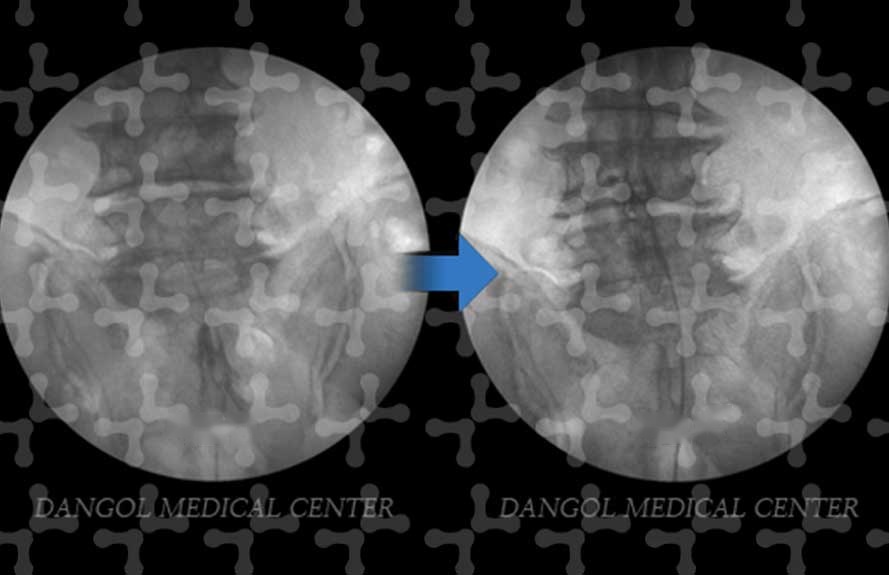 Before
After
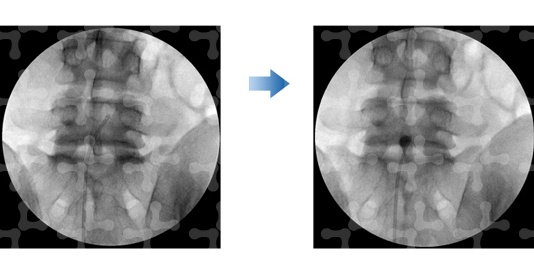 1. Catheter insertion
2. Balloon dilation of the narrowed area