



Before surgery: the inner joint space of the knees is narrowed and the legs are bowed.


High tibial osteotomy corrects bow-legged alignment to protect the knee joint.

1 hour

About 5 cm

Spinalor General

Minimal

After 1 week

Day after stitch removal

This surgery is performed for patients whose legs have become bowed (O-shaped) due to osteoarthritis. By correcting the joint angle, it spreads out the pressure concentrated on the inner side of the knee, preventing and treating arthritis without joint replacement.
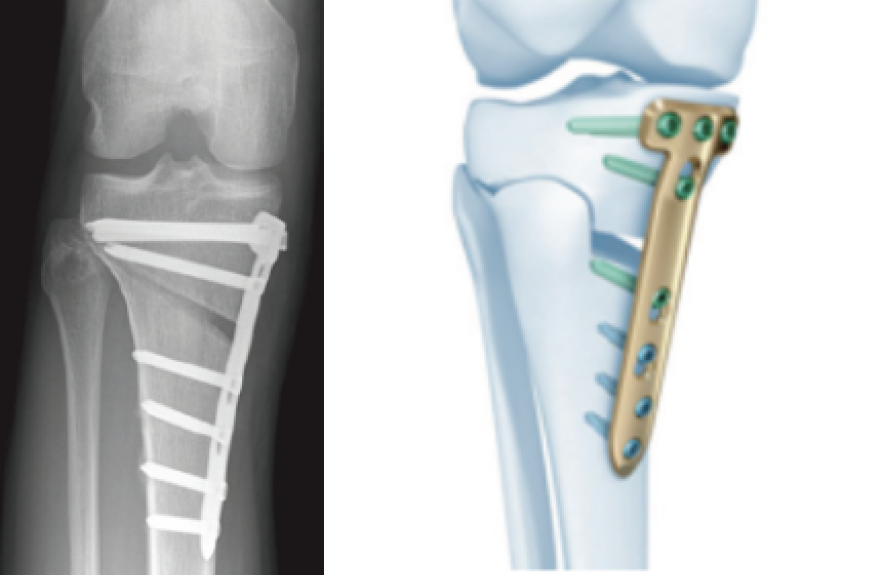
High tibial osteotomy does not operate on the knee joint itself; instead, a wedge-shaped cut is made in the shin bone to straighten the leg. A flat metal plate is then fixed with screws before the wound is closed, so that body weight is distributed evenly and stably.

Varus (bow-legged) deformity of the knee
Arthritis on the inner (medial) side of the knee
Good range of motion in the joint
No instability of the surrounding ligaments
Relatively young, active patients under 60
An incision is made in the upper part of the tibia (shin bone).
The bone is opened in a wedge shape as much as needed.
The bone is fixed internally with a flat metal plate.
A stem cell bone graft is performed.
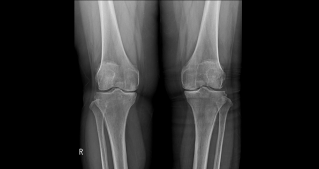
Before Surgery (X-ray)
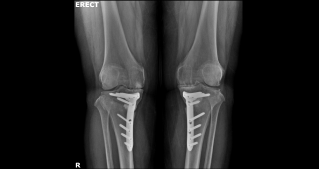
After Surgery (X-ray)
Before surgery: the inner joint space of the knees is narrowed and the legs are bowed.
After surgery: osteotomy was performed on each knee in turn from the inner side to straighten the bowed bones, followed by internal fixation (the inner joint space is wider than before surgery and the bowed knees are now straight).
After surgery, warmth, swelling, infection, complications or radiating pain may occur at the surgical site, so continuous care is needed.
Recovery varies from person to person depending on each patient's health and condition.
Be sure to follow the post-operative precautions and restrictions to prevent complications.
Avoid strenuous movements even if you feel no pain, and avoid going up and down stairs as much as possible.
After surgery, range-of-motion exercises for bending and straightening the knee and muscle-strengthening exercises are needed.
For the first 6 weeks, walk with crutches, putting only about 50% of your body weight on the leg.
Full weight-bearing is possible 6–8 weeks after surgery.


